Common Yoga Mistakes Beginners Make (and How to Avoid Injury)
Most beginner yoga injuries have nothing to do with being inflexible. They come from pushing into shapes the body isn't ready for, holding the breath, or following the person on the next mat instead of your own knees. The good news is that the fixes are simple, and they make yoga far more enjoyable. Here are the habits worth building from your very first class.
Let Alignment Lead, Not Depth
New students often assume the aim is to go further: hands closer to the floor, chest lower in a lunge, heels down in downward-facing dog. Depth is not the goal. A shape that suits your body is.
Downward-facing dog is a good example. Beginners are frequently told to press the heels into the mat. If your hamstrings are tight, forcing the heels down rounds the lower back and pushes weight into the wrists. Instead, bend the knees generously, lift the sitting bones towards the ceiling and press the whole hand — especially the base of each index finger — into the mat. The heels can hover. The spine gets long, which is the point.
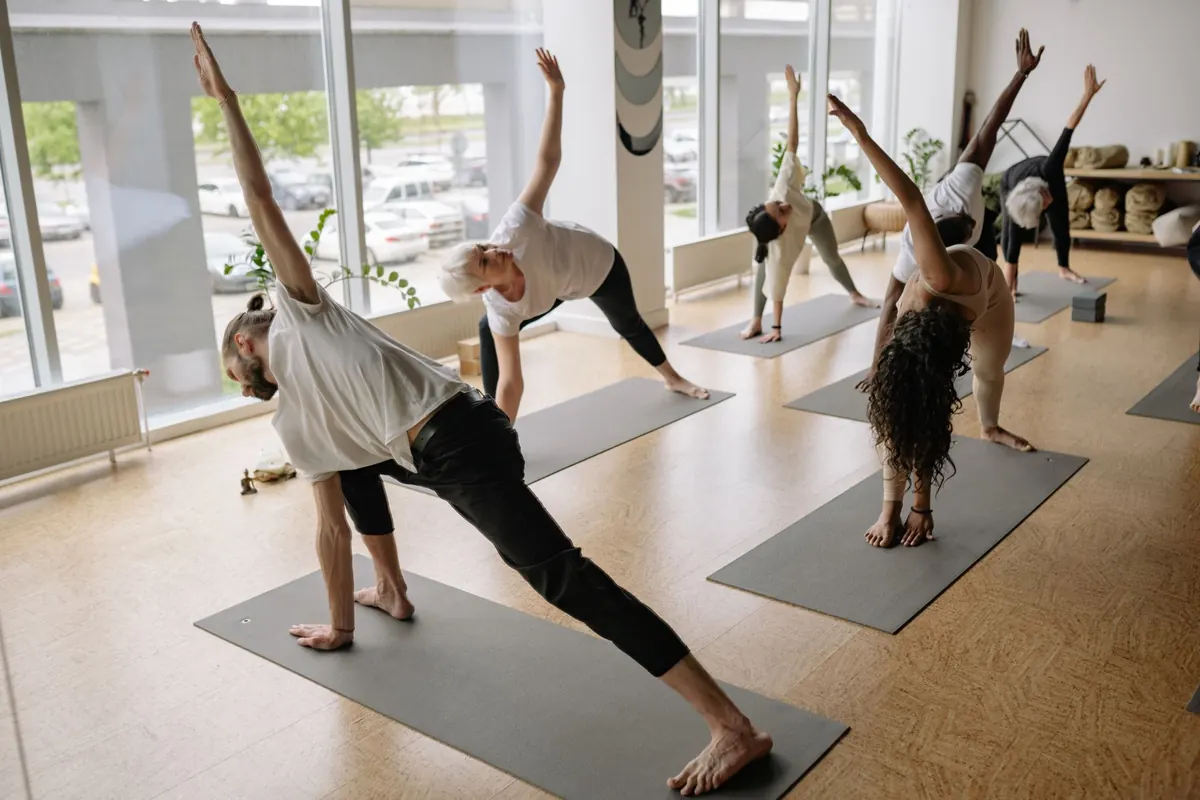
In warrior poses, watch the front knee. It should track roughly over the middle of the foot rather than collapsing inwards. If it does collapse, shorten your stance. A slightly narrower warrior with a stable knee teaches your body far more than a wide, wobbly one.
Three alignment habits worth repeating in every class:
- Ground down before you rise up. Feel both feet, or your sit bones, fully supported before extending anything.
- Keep the spine long. If a forward fold rounds your back, bend your knees or use a block under each hand.
- Stack joints where you can. In standing poses, knee over ankle, shoulder over hip, ear over shoulder.
If something pinches, tingles or feels sharp, that is information, not weakness. Come out of the pose, adjust, and try again. Dull stretch is fine. Sharp sensation is a signal to stop.
Breathe Before You Move
Holding the breath is one of the most common beginner habits, and it makes everything harder. Without breath, the muscles tense, the heart rate climbs and the nervous system reads the whole experience as a threat. That is when people push too far.
Try this: before you take the shape, take one full breath. Then move on an exhale into the pose and find a rhythm of steady breathing once you are there. If you cannot breathe smoothly, you have gone too far. Back off a centimetre or two and the breath usually returns.
Linking movement to breath — often called vinyasa — is not decoration. It gives your mind something simple to follow, which is why it reduces the temptation to compare, rush or drift off. If your teacher counts a breath in and out, use that. If they move quickly and you need an extra breath, take it. Nobody is marking you.
A quick breathing check
Place one hand on your ribs and one on your belly. Breathe in and feel the ribs widen sideways rather than the shoulders lifting. Breathe out slowly, longer than the inhale. Two or three of these between poses will reset your pace in a busy class.
Stop Measuring Yourself Against the Room
Comparison is the quiet injury risk. It tempts you to hold a pose longer than your shoulder likes, or to try a balance you have not built the strength for yet. Every body has a different history. Previous sport, old injuries, pregnancy, hypermobility, long hours at a desk — all of it changes what a pose looks like.
A useful rule: notice what others are doing, then come back to your own breath and your own baseline. Ask yourself whether you could hold this shape for five calm breaths. If not, take the version you can hold. That version is your practice today, and it will change from week to week.
Your practice is not a performance. The person on the next mat is a distraction, not a standard.
Use Props Properly — They Are Not Cheating
Blocks, straps, bolsters and blankets exist to bring the floor closer to you. Using them is a sign of good judgement, not a lack of ability. Many experienced teachers use more props than beginners do.
Some practical starting points:
- Blocks under the hands in forward folds, triangle or half moon so the spine can stay long.
- A strap around the feet in seated forward folds or reclining hand-to-big-toe pose when you cannot comfortably reach.
- A folded blanket under the hips in seated poses if your lower back rounds or your knees lift far off the floor.
- A bolster or two stacked blankets under the shoulders for restorative backbends and supported child's pose.
Set up before you need to. It is far easier to reach for a block at the start of a pose than to wobble out of it halfway through. If you practise at home, a couple of thick books and a rolled towel will do until you decide to buy anything.
Rest Is Part of the Practice
Savasana at the end of class is not a bonus for people with spare time. It is where the nervous system settles and the body absorbs the work. Skipping it to beat the traffic undoes some of the benefit.
Rest mid-class too. Child's pose is nearly always available, and a good teacher will not mind. Sit out a flow if your wrists ache, come to standing a breath later, or take a seated forward fold instead of a deep backbend. Learning when to rest is a skill that protects your joints for years.
Try to leave two or three minutes of quiet at the end of a home practice, even if it is just lying on your back with your knees bent and feet on the floor. It costs nothing and it changes how the rest of your day feels.
Building a Practice That Lasts
Start with two or three classes a week rather than five. Choose a beginners' course or a slower class where the teacher explains the shapes. Tell them about any injury, pregnancy or condition that affects your movement before class begins, and ask for alternatives when a pose does not work for you.
Warm up before deeper stretches, keep joints soft rather than locked, and avoid forcing your knees or neck into positions that feel wrong. If you have a health condition, are pregnant, or are returning from injury or surgery, check with a doctor, physiotherapist or qualified yoga teacher before starting — general advice cannot account for your individual circumstances.
Progress in yoga is quiet. It shows up as steadier breathing, fewer aches after class and a little more patience off the mat. Keep the alignment honest, breathe through the whole thing, use the props, and rest without apology. The rest takes care of itself.
Photo: Yan Krukau / Pexels
Yoga for Lower Back Pain: 8 Gentle Poses for Desk Workers
A beginner-friendly yoga sequence for desk-related lower back tension, with eight gentle poses, practical...
A Seasonal Guide to Holistic Wellness in the UK: Spring, Summer, Autumn, Winter
Small seasonal adjustments to food, movement, meditation and rest can keep you well through the British...
About Us